
Every RSA and CVRT obligation, in one record.
Traxsit is the single compliance hub for Irish fleets — tacho downloads, daily walkaround checks, defect and maintenance history and CVRT preparation, kept in one audit-ready record per vehicle. When an inspector calls, everything is already in place.
What the RSA actually wants — and where Traxsit covers it
Roadworthiness in Ireland comes down to a handful of obligations under S.I. 348/2013, the CVRT regime and EU drivers’ hours and tachograph rules. Here’s each one — and the Traxsit tool that handles it, so the evidence is captured the moment the work is done.
Daily walkaround checks
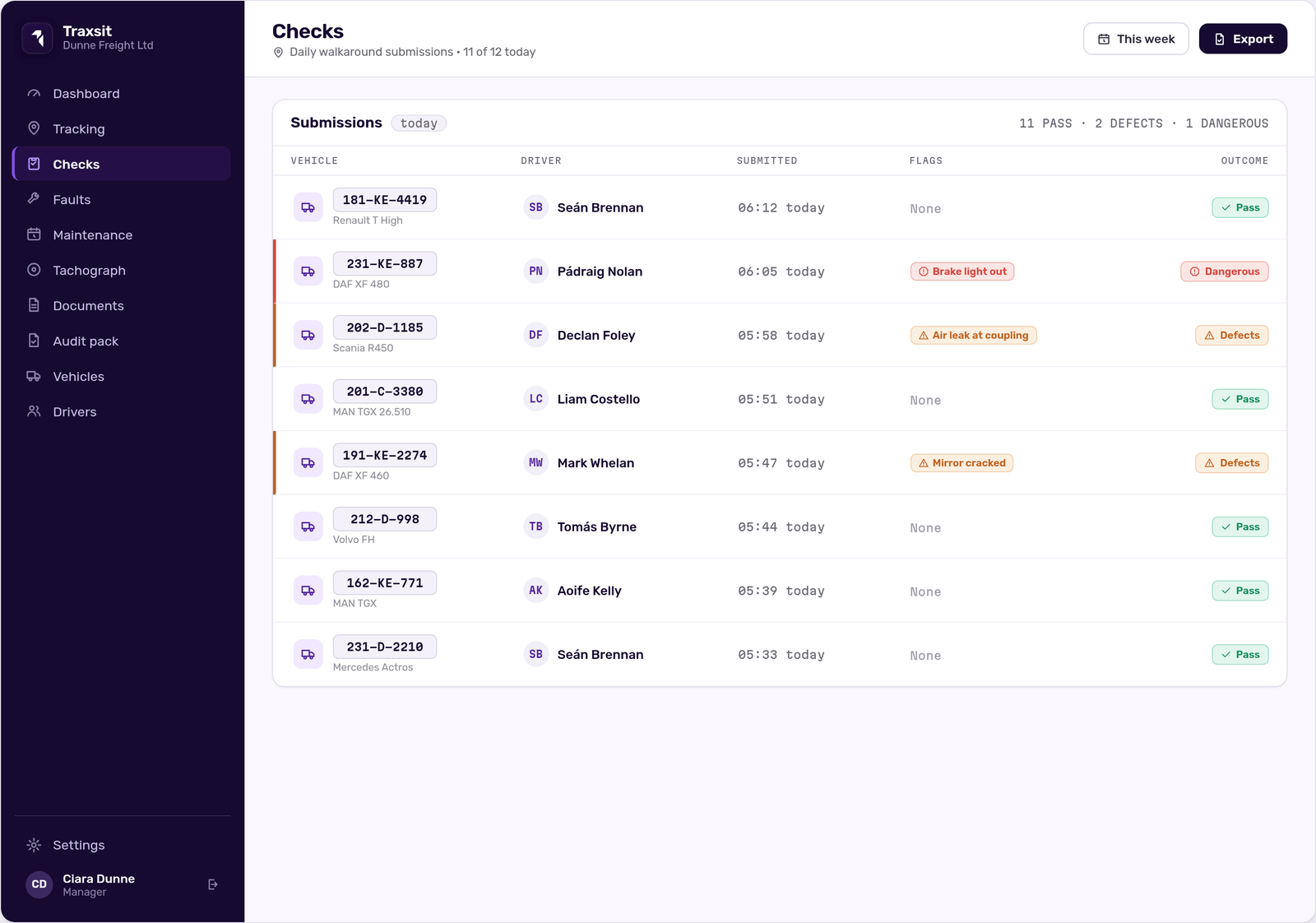
A trained person — driver or mechanic — must check the vehicle before first use, once per 24 hours, inside and out, against the Schedule 1 items. Traxsit guides each check on the driver’s phone and stores it with photos and a signature.
Walkaround Checks →Defect & maintenance records
Defect and maintenance records must be kept for at least 2 years under S.I. 348/2013, each noting the fault, the time and date found and the action taken. Traxsit turns every failed check into a tracked fault ticket and keeps the full repair trail.
Maintenance →Tachograph downloads
Driver cards must be downloaded every 21 days and vehicle units every 3 months, with the data kept for at least 12 months. Traxsit pulls both automatically, on schedule — no download keys, no walking the yard.
Tachograph Download →Drivers’ hours
Drivers and operators must keep within the daily and weekly driving limits and break rules — and be able to show it. Traxsit reads your downloaded files, detects infringements against the limits and sends them to the right driver.
Tachograph Analysis →CVRT preparation
Every commercial vehicle needs a valid CVRT pass and Certificate of Roadworthiness. Traxsit tracks CVRT, 13-week checks and service dates on one planner with RAG status and morning digests, so vehicles are presented prepared rather than hoping to pass.
Maintenance & CVRT →Tracking, checks, maintenance and tacho all write to the same per-vehicle record — so the evidence for every obligation above lives in one place. See the whole platform →
RAG status across the whole fleet, at a glance
Traxsit colours every compliance event green, amber or red — passed, due soon or overdue — so a transport manager sees the whole fleet’s standing in one screen and acts before anything bites. Morning email digests flag what’s coming due, vehicle by vehicle.
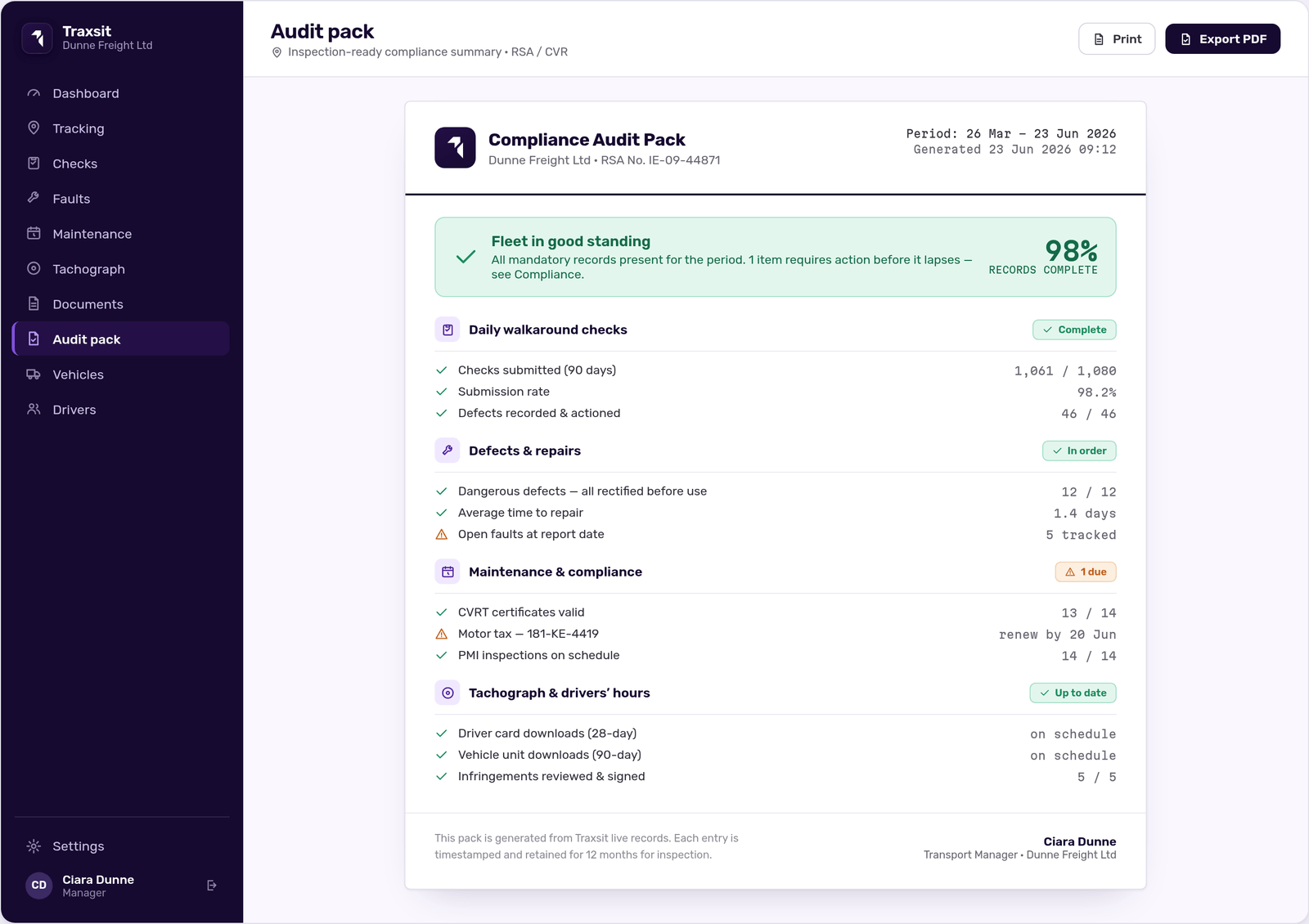
One-click RSA audit pack
The whole point of putting compliance in one record: when the RSA calls, the binder is already assembled.
Pull every check, download and service record into one export
Because every walkaround check, tacho download and maintenance job writes to the same per-vehicle record, Traxsit can gather them into a single export — the complete compliance and maintenance story for a vehicle, ready to hand over. No ring binders, no night-before scramble across four systems.
- Every signed, photographed walkaround check
- Tacho download history — driver cards and vehicle units, retained at least 12 months
- Defect and repair trail kept for at least 2 years (S.I. 348/2013)
- CVRT, 13-week checks and service history with dates
Check, maintain, download, analyse — under one login
Four tools that each satisfy part of the RSA picture, and join up because they share one record. Explore the tool behind each.
Daily walkaround checks
Guided Schedule 1 checks on the driver’s phone — pass/fail per item, photo and signature on every one, before the wheels turn.
Walkaround Checks →Defects, jobs & CVRT
Failed checks become tracked faults, faults become work orders, and CVRT, 13-week checks and service sit on one planner. Records kept at least 2 years.
Maintenance →Tachograph downloads
Driver cards every 21 days and vehicle units every 3 months, pulled automatically and kept for at least 12 months — no keys, no yard walk.
Tachograph Download →Drivers’ hours analysis
Those downloaded files are read against the driving and rest limits, infringements detected automatically and sent to the right driver.
Tachograph Analysis →Fleet compliance questions, answered
The figures below are the Irish rules from the RSA, cvrt.ie and the relevant statutes — the same ones Traxsit is built to keep you the right side of.
How often must tachograph data be downloaded in Ireland? +
In Ireland the driver card must be downloaded at least every 21 days and the vehicle unit at least every 3 months, in line with RSA and cvrt.ie guidance. Traxsit performs both downloads automatically on schedule and keeps the files for at least 12 months.
How long must vehicle maintenance records be kept in Ireland? +
Maintenance and defect records must be kept for at least 2 years under S.I. 348/2013 (Regulation 10(3)). Each record should describe the defect, the time and date it was found and any action taken. Traxsit retains the full check, fault and repair trail for every vehicle so the two-year obligation is met automatically.
How long must tachograph records be kept? +
Tachograph data — driver card and vehicle unit downloads — must be retained for at least 12 months. Traxsit stores every download securely in the vehicle record, so the retention period is covered without anyone managing files by hand.
Who can carry out a daily walkaround check? +
A walkaround check must be done by a competent, trained person — this can be the driver or a mechanic — before the vehicle is first used and no more than once in any 24-hour period. It must cover the interior and exterior and the Schedule 1 items, including the tachograph. Traxsit guides that exact check on the driver’s phone and records who did it, when, with photos and a signature.
What is a CVRT? +
The CVRT is the Commercial Vehicle Roadworthiness Test — the annual roadworthiness test for commercial vehicles in Ireland, administered under the RSA’s CVRT regime. A pass results in a Certificate of Roadworthiness (CRW). Traxsit tracks CVRT due dates alongside 13-week checks and service on one planner with RAG status and morning digests, so vehicles are presented prepared.
What are the daily driving limits for drivers’ hours? +
The daily driving limit is 9 hours, which may be extended to 10 hours no more than twice a week, with a maximum of 56 hours in a week and 90 hours in any fortnight. A driver must take a break of at least 45 minutes after 4.5 hours of driving. Traxsit’s tachograph analysis checks downloaded data against these limits and flags infringements automatically.
Not sure where your fleet stands with the RSA?
Book a 20-minute demo and we’ll show you the whole compliance picture on a fleet like yours — checks, tacho, maintenance and CVRT in one record. Or talk to a real person in Cork.