
Your tacho files have stories to tell. We read every one.
Downloading the files is only half your obligation. Analysing them is what actually keeps you compliant — catching infringements early, keeping drivers informed before small slips turn into real penalties, and keeping driver and operator alike out of trouble. Traxsit analyses every file automatically — the same files we already download — and turns them into plain-English infringement reports, driver notifications and a clean audit trail.
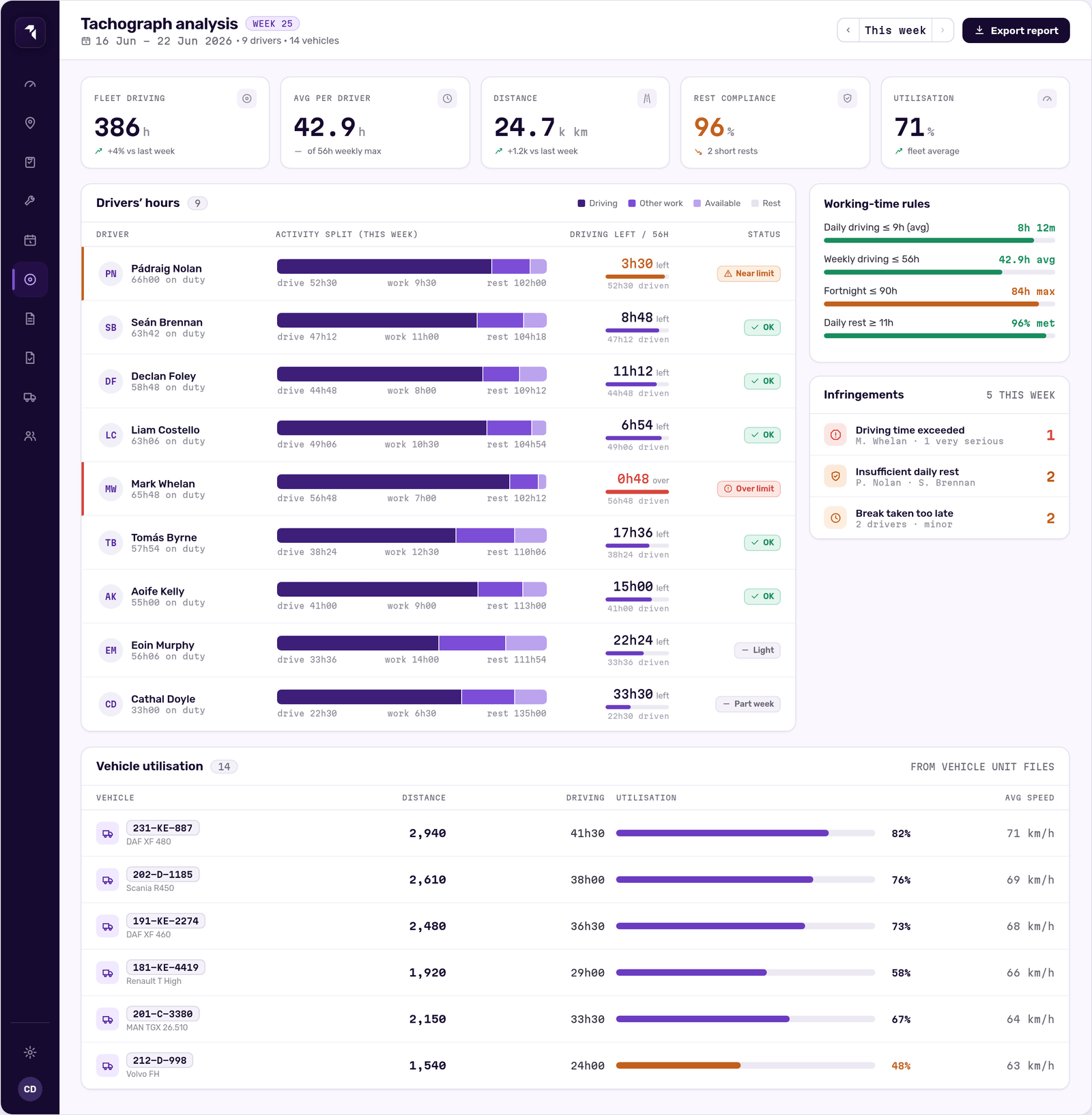
Visualise every file — automatically
Every download is read the moment it arrives — scored, sorted and ready to act on.
Automatic infringement detection
Daily driving over 9/10 hours, missed breaks after 4½ hours, short rests, missing mileage, card-not-inserted events — flagged the moment files arrive, scored by severity.
Driver hours summaries
Each driver’s daily and weekly driving, working time and rest rolled up into a clear summary, so you can see who is close to a limit before they cross it.
Drivers told, not ambushed
Infringements go to the driver in the app with a plain-English explanation of what happened and the rule behind it. Drivers sign off digitally; the debrief is on record.
Missing-mileage & missing-data flags
Gaps in the record — missing mileage between downloads, card-not-inserted periods and other data holes — are surfaced so they can be explained before an inspector finds them.
Working time, covered
Driving limits, working time and rest requirements tracked together, so nothing slips between two reports or two systems.
Audit-ready reports
Infringements by driver, depot and severity; trends over time; the evidence of a working compliance system that the RSA wants to see — exportable in a click.
See who can still drive — today, this week, this fortnight
Traxsit keeps a live running total of every driver’s hours straight from their tacho data — driving time, working time and how much they have left before they hit a limit. It turns raw files into the one thing a transport manager needs at 7am: who can take the next job, and who can’t.
- Live running totals of driving and working time, per driver
- Hours remaining today, this week and across the fortnight
- Monitored and flagged against EU drivers’ hours rules and the Working Time Directive
- Catch a driver nearing a limit before you assign work — and before it becomes a costly fine
Why it beats desktop tacho software
One system: the files download automatically and get analysed automatically.
Real time, not weeks later
Old desktop tacho software only reads last month’s files once the USB sticks are plugged in. Traxsit reads each file the moment it downloads, so an infringement is on the driver’s screen days — not weeks — later.
In the same platform
Your tacho data lives beside the same drivers’ walkaround checks and the same vehicles’ maintenance files — one login, one record, no second system to chase.
No re-keying, no manual uploads
No plugging USB sticks into a PC, no manual upload chore, no per-record surprise fees. The same files Traxsit downloads flow straight into analysis — nothing typed twice.
The rules behind the flags
Drivers’ hours in Ireland limit daily driving to 9 hours (10 hours twice a week), with a 45-minute break after 4.5 hours of driving. Weekly driving is capped at 56 hours and fortnightly driving at 90 hours. Tachograph data must be kept available for inspection for at least 12 months. Enforcement is by the RSA, with roadside checks and operator premises audits, and operators can face penalties of up to €5,000 and/or 6 months per offence. The best defence is a documented system: download on time, analyse everything, debrief every infringement. Full guide: fleet compliance in Ireland →
Smart Tachograph 2 is coming
Smart Tachograph 2 becomes mandatory for 2.5–3.5 tonne vans on international journeys from 1 July 2026. If your light commercials cross a border, they will need to be in scope — downloaded and analysed like the rest of your fleet. Traxsit handles those files the same way: collected automatically, read automatically, infringements flagged.
Download and analysis, one workflow
Already downloading with us? Analysis reads every file the download collects.
Automatic remote pulls — driver cards every 21 days, VU every 3 months, stored securely.
Download →Turns those files into infringements, driver reports and notifications — no spreadsheets.
Analyse →Tachograph analysis questions
What is tachograph analysis? +
Tachograph analysis is the process of reading the data in driver card and vehicle unit downloads to check it against drivers’ hours and working time rules. It identifies infringements — such as too much daily driving or missed breaks — and turns the raw files into reports a transport manager can act on. Traxsit does this automatically on the same files it downloads for you.
What are the most common infringements? +
The most common drivers’ hours infringements are exceeding the 9-hour daily driving limit (10 hours is allowed only twice a week), failing to take a 45-minute break after 4.5 hours of driving, taking too little daily or weekly rest, and gaps such as missing mileage or card-not-inserted periods. Traxsit flags each one the moment the file arrives and scores it by severity.
How does this help us avoid fines? +
Drivers’ hours and Working Time Directive breaches carry real penalties — up to €5,000 and/or 6 months per offence in Ireland, and both the driver and the operator can be liable. Traxsit catches infringements the day the file downloads, tells the driver before the same mistake repeats, and builds the documented, acted-on compliance record that stops a roadside check or RSA audit turning into a fine.
Do drivers get notified of their infringements? +
Yes. When an infringement is detected it goes to the driver in the app with a plain-English explanation of what happened and the rule behind it. The driver signs off digitally, so the debrief is recorded as evidence that you run, and act on, a compliance system.
Do I still need separate tacho software? +
No. Old desktop software only analyses last month’s files once someone plugs the USB sticks in; Traxsit analyses each file the moment it downloads, in the same platform that holds your tracking, walkaround checks and maintenance records. That means no posting, no monthly upload chore, no per-record fees and no second login.
When is Smart Tachograph 2 mandatory? +
Smart Tachograph 2 becomes mandatory for 2.5–3.5 tonne vans on international journeys from 1 July 2026. If your light commercials cross a border they will need to be in scope. Traxsit downloads and analyses those files the same way as the rest of your fleet.
Ready to read every file, not just collect them?
Book a 20-minute demo, or talk to a real person in Cork.