
No more paper check sheets, walkaround checks your drivers will actually do.
Our vehicle check app streamlines the whole driver-check process. The right checklist loads on the driver’s phone, pass or fail each item, photograph a fault, sign, submit. All in under a minute, gloves on, in the yard. It’s intuitive enough that drivers actually do it, there are no more lost or illegible paper check sheets. Every failed item becomes a tracked fault before the vehicle leaves the yard.
From pocket to audit trail in four steps
The right checklist loads for the asset, the driver works through it gloves-on, and the record writes itself.
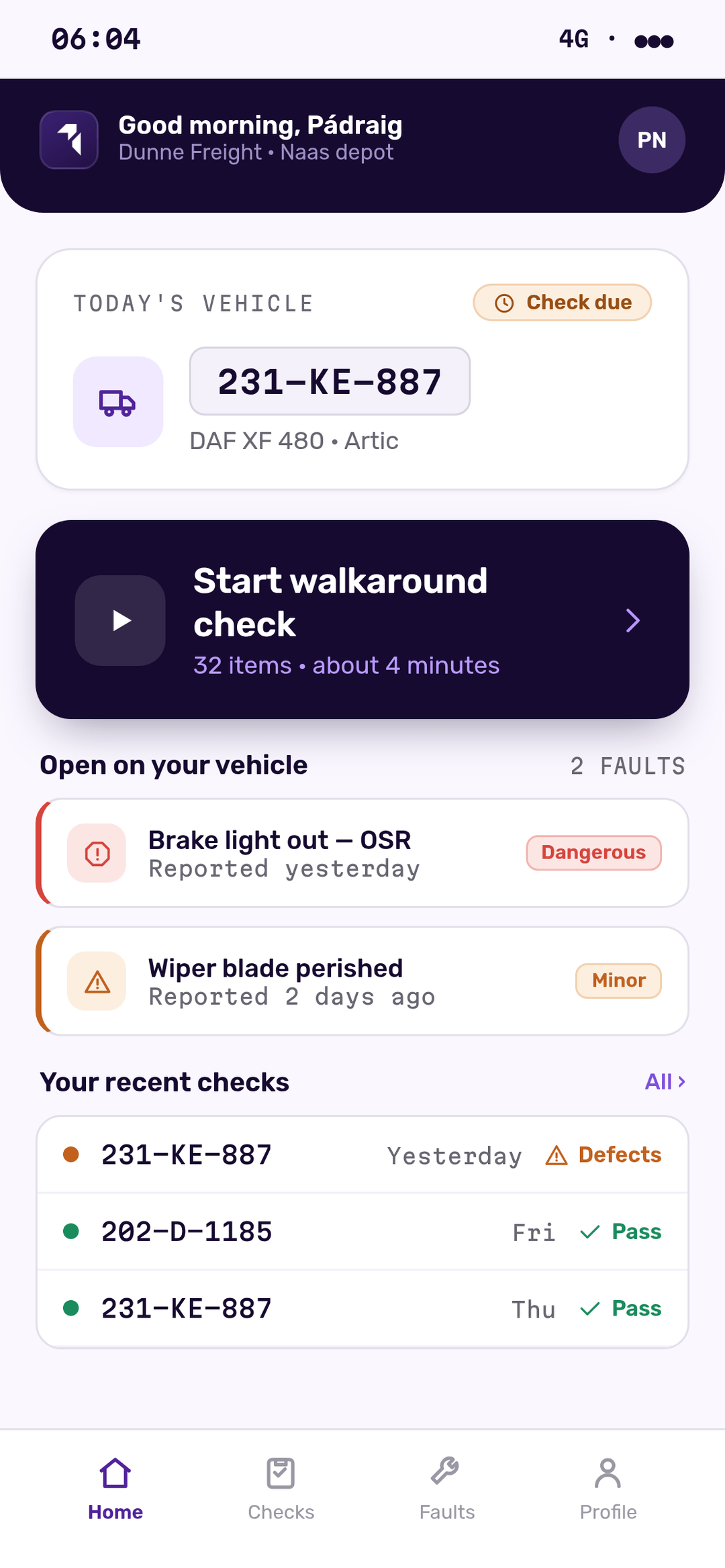
1. Open the app at the vehicle
It’s installed on the home screen like any app, and the right checklist loads for that asset — HGV, van, trailer or machine.
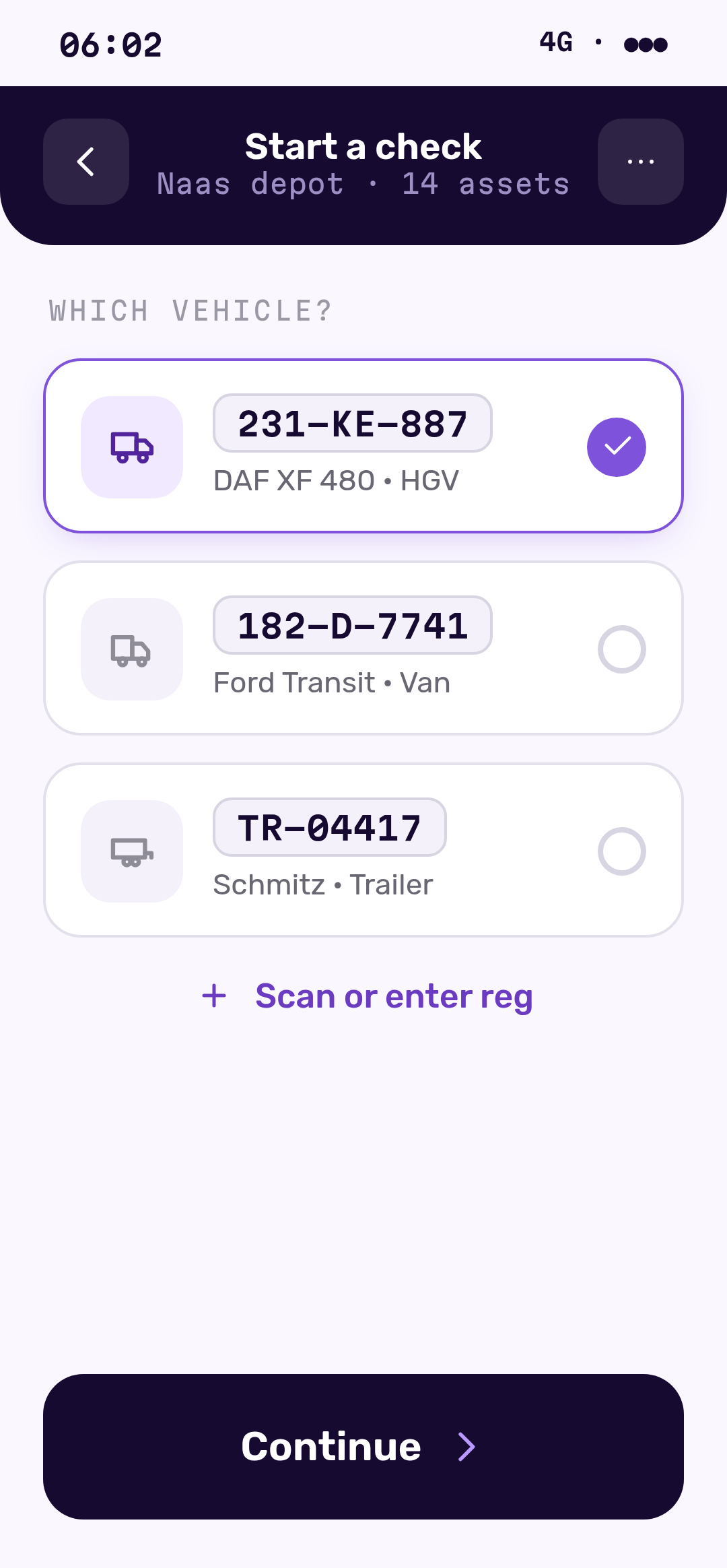
2. Pass/fail, item by item
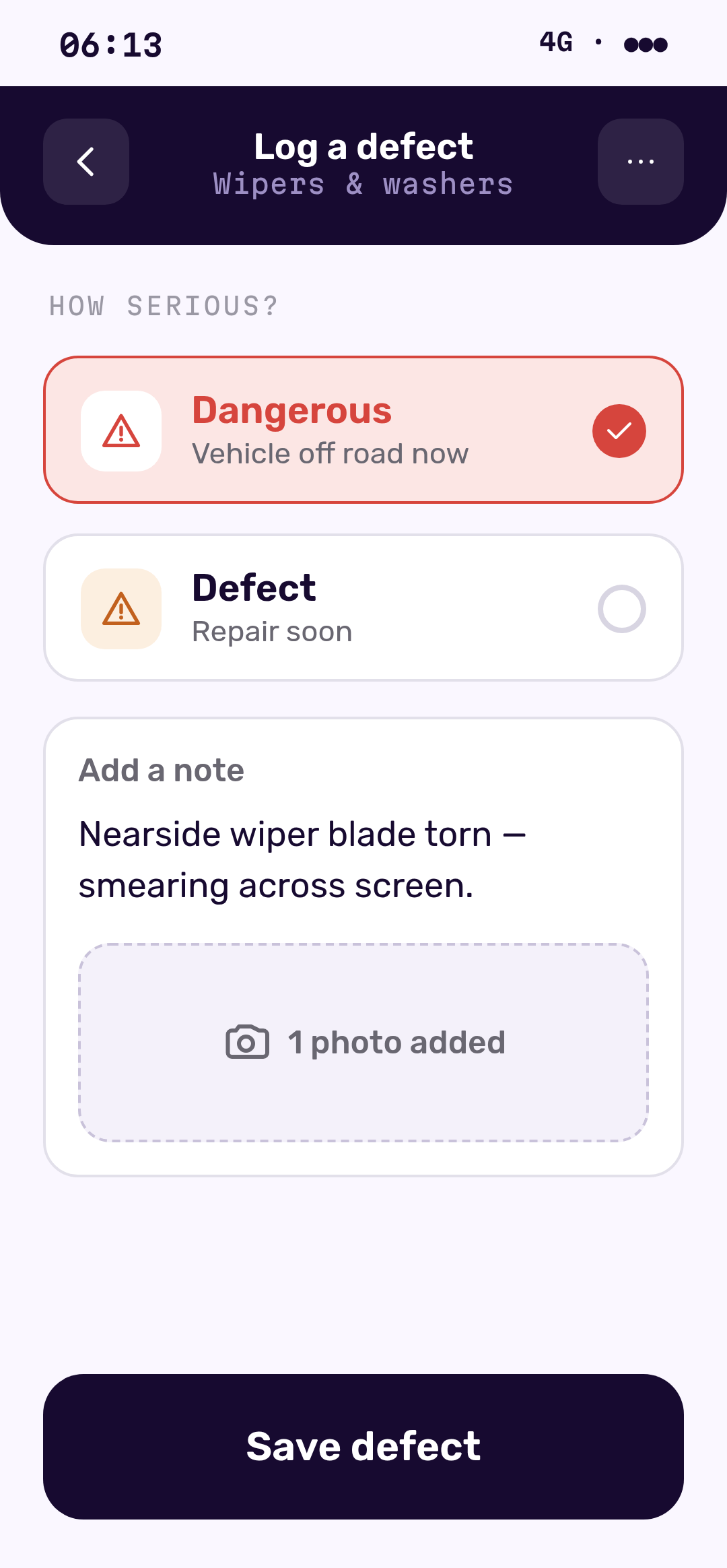
Big touch targets built for gloves-on yard use. Spot a fault? Photograph it on the spot. A proper check takes under a minute.
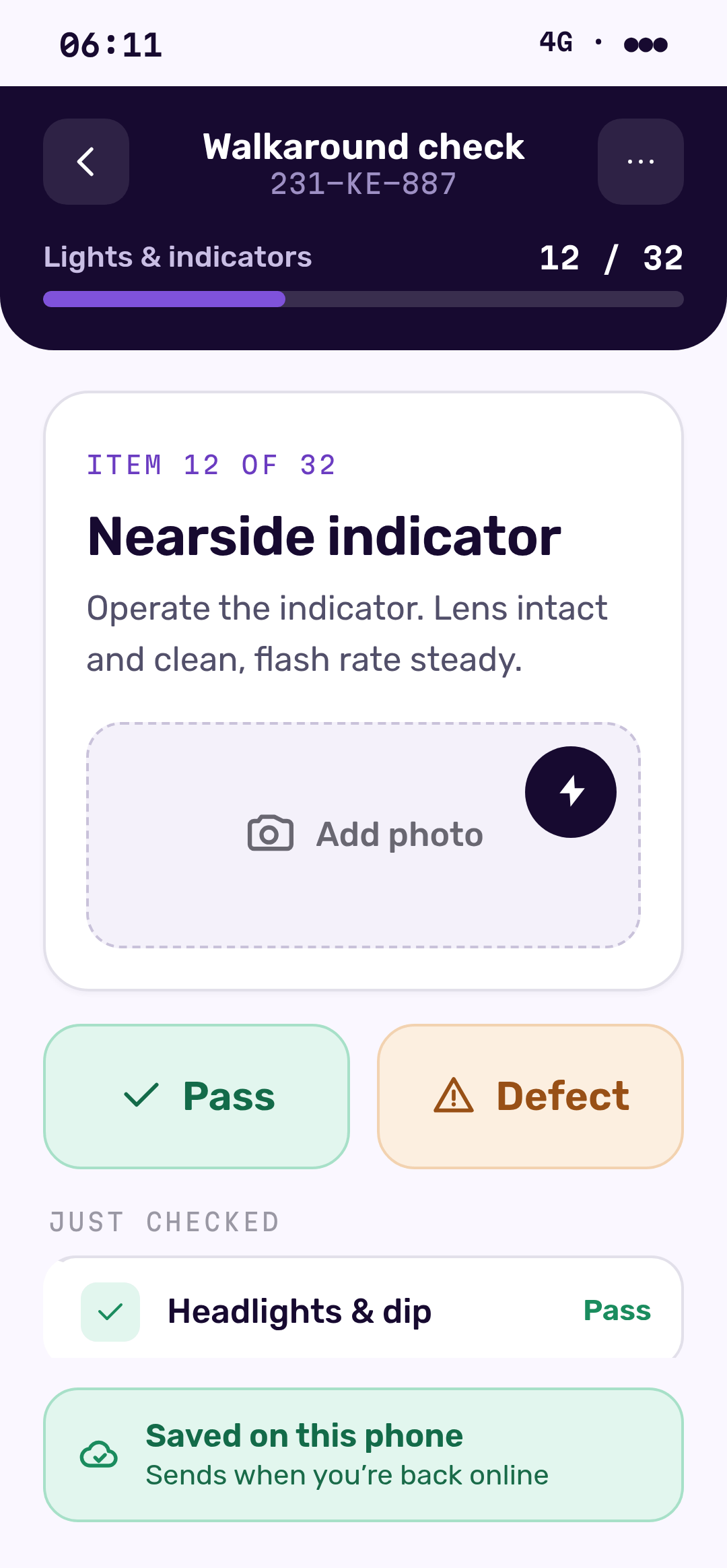
3. Sign and submit
The driver signs on screen; the check is time-stamped and stored against the vehicle with photos and signature attached. No edits after the fact — the audit trail stays honest.
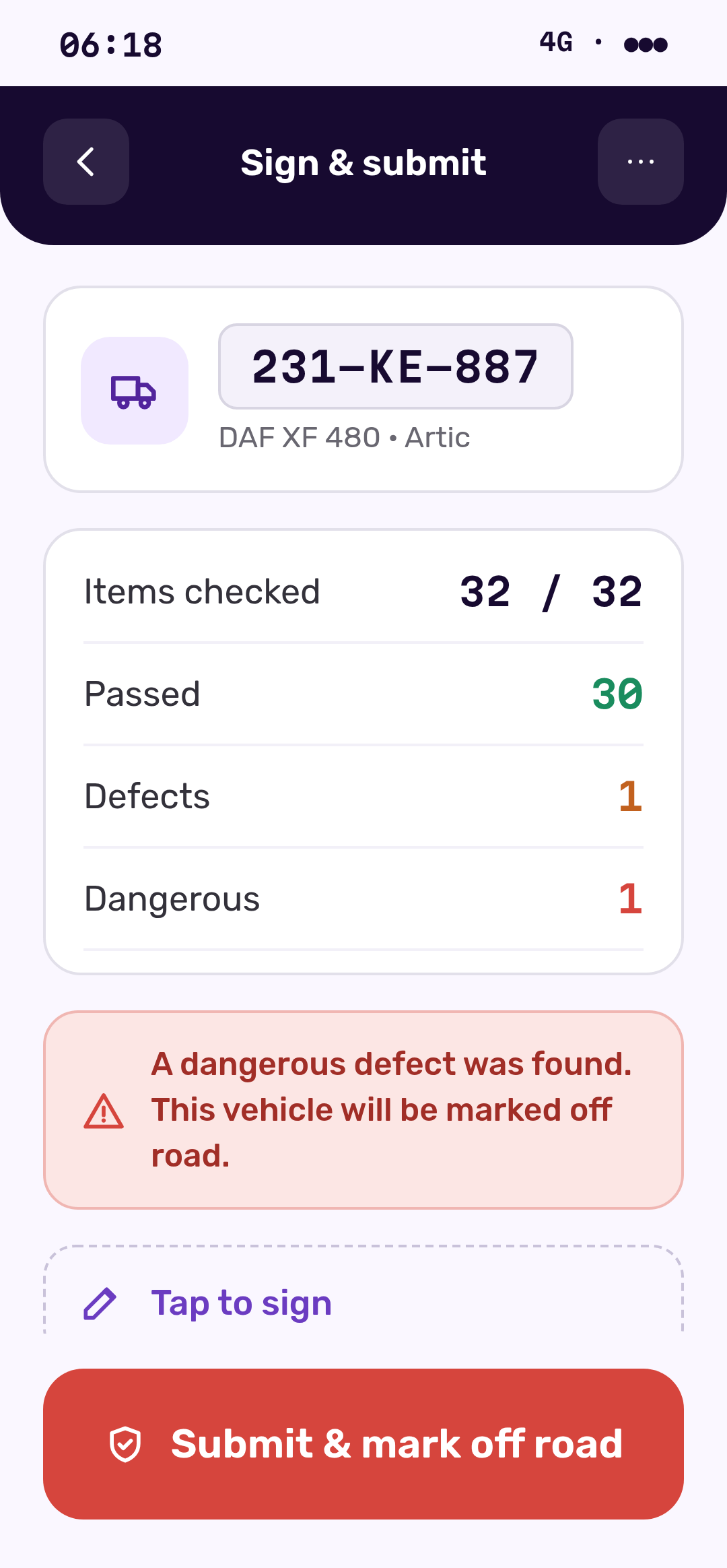
4. Failed items become fault tickets
Automatically. Every fail lands on the live fault board with a status workflow, so nothing gets lost between the yard and the workshop.
One app drivers will actually use and managers can rely on
For drivers
It’s a real app, not a webpage.
- Installs to the home screen — one tap from pocket to checklist
- Big touch targets that work with gloves on, in the rain, in the dark
- A morning push reminder so the check happens before the wheels turn
- Push notifications when a fault they reported gets an update — drivers see things get fixed
- Photos beat writing essays; every signed check is the driver’s own record too
For transport managers
See the gaps, chase the right people.
- See at 8am who’s checked and who hasn’t — and chase the gaps, not the paperwork
- Every check on the dashboard with its photos and the driver’s signature
- Faults arrive as tickets with photos, not descriptions like “brakes funny” — each with a status you can track from reported to fixed
- Records organised per vehicle, per driver, per day — RSA-inspection-ready, always
- One-click audit pack: print the full check, fault and maintenance story for any vehicle when the RSA calls
Built around RSA and CVRT obligations — not imported UK templates
Under Irish law the daily walkaround and its records are exactly what an RSA premises inspection examines. Traxsit is built to produce them.
Walkaround before first use
Under the RSA roadworthiness rules a trained, competent person must carry out a walkaround check before a vehicle is first used — and at most once in any 24-hour period.
Defects recorded properly
Every defect must be recorded with a description of the defect and the time and date it was found. Traxsit captures all three automatically, plus a photo and the driver who reported it.
A dangerous defect stops the vehicle
A check isn’t a formality. Where a walkaround finds a dangerous defect, the vehicle must not be used until it is put right — and the record shows exactly when it was found and when it was fixed.
Irish law (S.I. 348/2013) requires maintenance and defect records to be kept for at least 2 years. Traxsit holds every signed check, photo and fault for that long as standard, with RSA-aligned checklists for HGVs, LGVs, trailers and plant out of the box — covering tyres, lights, coupling, load security, the tachograph itself and the rest. Each organisation’s data is fully isolated; your fleet’s records are yours alone.
Vehicle check locations, remaining drivers’ hours, driver infringements.
Tachograph integration and live vehicle tracking views are planned for the driver app. Drivers’ hours and vehicle locations alongside their checks and faults. They are not in the app yet. Both already exist as live Traxsit products, though: automatic tachograph download and GPS fleet tracking have been running on 1,200+ vehicles for over 5 years.
Driver checks are just one element in the complete compliance record.
Every fault a driver reports flows straight into maintenance. The same vehicle carries its tracking, service & tacho history too.
Maintenance & 13-week checks
Every reported fault becomes a ticket, a work order, a repair and a line in the vehicle’s history — with 13-week check and CVRT dates tracked.
See maintenance →Vehicle tracking
Live GPS for vans, trucks and plant on one map, feeding mileage and engine hours to the same fleet your checks belong to.
Explore tracking →Tachograph download
Driver cards and vehicle units pulled remotely — cards every 21 days, VU every 3 months — no USB sticks.
See tacho download →It all rolls up into one audit-ready record — see the fleet compliance hub.
Walkaround check FAQs
What does Irish law require for a daily walkaround check? +
Under the RSA roadworthiness rules a trained, competent person must carry out a walkaround check before a vehicle is first used, and at most once in any 24-hour period. Any defect found must be recorded with a description and the time and date it was found, and a vehicle with a dangerous defect must not be used until it is put right. Traxsit’s checklists and records are built around exactly these obligations.
How long does a check take on the app? +
A proper walkaround on the Traxsit Checks app takes under a minute. The right checklist loads for the asset, the driver taps pass or fail per item with big gloves-on touch targets, photographs any fault, signs and submits — all from their phone at the vehicle.
How is the app better than paper check sheets? +
Paper sheets get rained on, pencil-whipped and lost before the audit. The app time-stamps every check, locks it after submission so it can’t be edited, attaches photos and a signature, and organises records per vehicle, per driver, per day. The RSA explicitly accepts an electronic solution in place of a paper check book.
What happens when a driver fails an item? +
Every failed item becomes a fault ticket automatically, landing on the live fault board with the photo and the driver who reported it. The ticket carries a status you can track from reported to fixed, and it flows straight into Traxsit maintenance as a work order — so nothing gets lost between the yard and the workshop.
How long are check and defect records kept? +
Irish law (S.I. 348/2013) requires maintenance and defect records to be kept for at least 2 years. Traxsit holds every signed check, photo and fault for that long as standard, with each organisation’s data fully isolated, so your full check, fault and maintenance history is ready whenever an RSA premises inspection asks for it.
Ready to put the walkaround on every driver’s phone?
Book a 20-minute demo, or talk to a real person in Cork.